We vs I: The Lesson of Six Bikes
When you've been with a team for more than a decade, you don't just see wins and losses. You watch a program grow. You watch coaches stay committed to a vision. You watch young athletes come and go, each leaving their mark on the culture.
We've had the privilege of working with TCU Women's Soccer since 2015. Year after year, we've watched them become one of the premier programs in the country. It hasn't happened by accident. It's been built through intentional leadership, relentless standards, and coaches who care deeply about developing people, not just players.
Then came the best season in program history.
A Final Four finish.
With that success came enormous expectations.
At the same time, the roster had changed dramatically. Fifteen new players were joining the team after a large senior class graduated. The talent was there, but every coach knows talent doesn't automatically become a team. Trust has to be built. Relationships have to be formed. A shared identity has to be created.
That's why they invited us back.
For years, Eric and I had talked about leading one specific experience with this team. We'd kicked around ideas, refined the concept, and waited for the right opportunity. Every season it felt close, but never quite right.
This time was different.
The timing was perfect. A team with incredible potential. New relationships waiting to be formed. Expectations as high as they'd ever been. It wasn't just about preparing for another season. It was about intentionally building the culture that could sustain success.
We knew this was the year.
We have had the privilege of partnering with the Texas Christian University Women’s Soccer program since 2016. Every year brings a new team. This year, they entered the room with fifteen new players and twelve returners. New faces. New relationships. New expectations. New dynamics to navigate.
They are a championship-caliber program filled with incredibly talented athletes. But talent alone does not create trust. A roster can be assembled through recruiting. A true team has to be built.
Much of our work is about creating the conditions where that kind of team can begin to form. We place people in unfamiliar, challenging situations because pressure has a way of revealing what already exists.
Who steps forward?
Who steps back?
Who listens?
Who takes over?
Who becomes frustrated when someone learns differently?
Who notices the teammate standing quietly on the outside?
Those moments give teams an opportunity to examine not merely what they accomplish, but how they accomplish it.
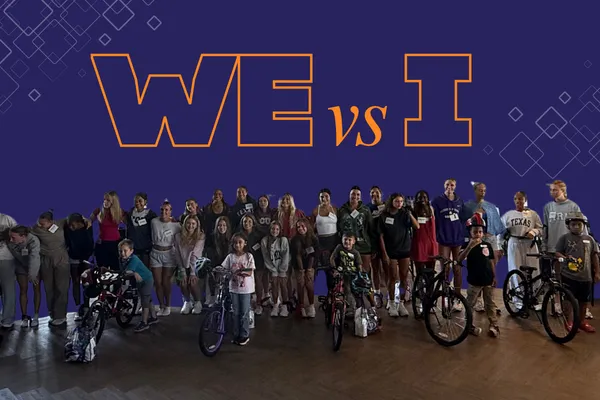
This weekend, the lesson came through six bicycles.
Lead On
Giving back is deeply connected to who TCU is as a university and an athletic program. When you step onto campus, you see a simple but powerful charge:
Lead On.
We wanted to create an experience that allowed the players to live that message not through a discussion, but through action. With help from TCU and a local educator, we connected with a nearby Title I school. School leaders identified six children whose families could especially benefit from receiving a bicycle.
We purchased six bikes and gave the team its assignment: Plan the process. Organize the people. Build the bikes. Prepare a meaningful presentation for each child. And figure it out together.
There were no experts in the room, and that was the point.
These young women know how to compete at one of the highest levels of collegiate athletics. They understand conditioning, preparation, sacrifice, pressure, and performance. But place unfamiliar tools in their hands and ask them to assemble a bicycle, and suddenly they are beginners again.
They had to ask questions.
They had to listen.
They had to make mistakes.
They had to help one another.
They had to become students.
Most importantly, they had to move from “I” to “we.”
What an “I” Mentality Costs a Team
Elite athletes have spent much of their lives working to stand out. They played club and academy soccer. Their families sacrificed time, money, weekends, and vacations. They traveled to tournaments, created highlight reels, contacted coaches, and competed for limited opportunities. Their talent earned attention, and their discipline helped carry them to a Division I field.
That deserves to be honored. It also creates a responsibility to maintain perspective.
There are children who love the game just as deeply but may never have access to club fees, private training, extensive travel, or recruiting exposure. Their starting line is different. Not because they lack heart, potential, or work ethic, but because opportunity is not distributed equally.
Leadership asks us to recognize both truths: Be grateful for what your sacrifices helped you earn, and remain aware of the people who have never been given the same opportunity.
In sports, business, families, and communities, an “I” mentality narrows our vision. We begin protecting our position, comparing ourselves, keeping score, or focusing only on what we need. But no meaningful team is built that way.
A team becomes powerful when people begin asking different questions:
Who needs help?
Who has not been heard?
What can I contribute?
How do we succeed together?
What can we build that none of us could build alone?
Six bikes offered a simple answer.
Then the Children Walked In
Once the bikes were finished, the players prepared to present them. Then the children and their families walked into the room.
The players heard pieces of their stories. They called each child forward, surrounded them, celebrated them, and presented them with a new bike and TCU gifts.
The children’s faces lit up.
At six and seven years old, they probably weren’t thinking about leadership, opportunity, or the deeper meaning behind the moment. They saw brand-new bikes with cool helmets, TCU gifts, and a room full of soccer players cheering just for them.
They smiled, climbed onto the seats, and gripped the handlebars. “This is mine!”
For a parent, the moment may have said: Someone sees our family. Someone understands that life can be difficult. Someone cared enough to show up without asking for anything in return.
And for the players, the moment offered a reminder that their influence extends far beyond the soccer field. They did not merely build bicycles. They created a moment of connection, encouragement, joy, and hope.
Permission to Be a Student
The bikes carried another lesson. Whenever we encounter something unfamiliar, it is easy to feel embarrassed about not knowing what to do.
Someone with years of experience may look at the task and say, “Come on. It isn’t that difficult.” But when you have never seen it, touched it, or attempted it before, it is difficult.
Every expert was once a beginner.
Every leader has had to ask questions.
Every high performer has faced something that made them feel uncertain.
Growth requires giving ourselves permission to become students and to approach the learning curve with curiosity rather than shame. Strong teams create room for that. They do not punish people for what they have not yet learned. They teach, encourage, communicate, and help one another improve. They recognize that today’s beginner may become tomorrow’s teacher.
That is how capability grows. That is how trust grows. That is how a collection of individuals becomes a community.
Leadership Is Influence
We sometimes reserve the word “leader” for the person with the title, the office, the captain’s band, or the microphone. But leadership is influence.
You influence through the way you communicate under pressure.
You influence through the way you respond to someone who is struggling.
You influence through what you celebrate, what you tolerate, and what you model.
You influence others when you make room for them.
You influence when you choose curiosity over judgment, service over self-protection, and “we” over “I.”
The question is not whether you are influencing people.The question is: What kind of influence are you having? Are you leading from fear, comparison, anxiety, and the need to prove yourself? Or are you leading with compassion, gratitude, courage, and a willingness to make the people around you better?
It Starts With Someone Saying Yes
This experience also challenged me personally. For more than a year, I had felt a desire to become more involved in serving our community. It was on my vision board. I prayed about it, thought about it, and repeatedly asked myself, “How can I make a greater difference?”
But business became busy. Life felt overwhelming. I kept convincing myself I did not have enough time. Then Morgan, who leads a nonprofit called The Cause, reached out. She told me she had been afraid to ask, but she wanted to know whether I would consider serving on the board.
She thought I might say no. What she did not know was that I had been waiting for an opportunity to say yes.
That conversation reminded me of something important.When we are afraid to ask, the answer is already no. We do not have the opportunity, the partnership, the help, or the connection because we have not stepped forward.
But when we find the courage to ask, a door may open. Someone may have been waiting for the invitation. Someone may have been praying for an opportunity to contribute. Someone may be ready to help but unsure where they are needed.
Sometimes leadership is building the bike.
Sometimes it is purchasing the bike.
Sometimes it is identifying the child.
Sometimes it is coaching the team.
And sometimes leadership is simply having the courage to ask, “Would you be willing to help?”
More Than a Team-Building Exercise
The TCU players created core memories this weekend for themselves and for six children and their families.
Yes, it was part of a team-building experience. But it became much more than an exercise. It became an opportunity to see beyond individual roles and personal ambitions. It became a reminder that great teams are defined not only by what they achieve together but also by what they contribute together.
A group of talented individuals can build an impressive roster. But it takes a “we” to build a team. It takes a “we” to build trust. It takes a “we” to build hope. And sometimes, it takes a “we” to build six bicycles that tell six children:
You are seen. You are valued. And your dreams matter.
That is leadership.
That is influence.
That is what it means to Lead On.